Bedroom
18 Scandinavian Bedroom Ideas That Help You Actually Sleep

Jump to section
- The visual noise problem
- Stop using the ceiling light after 6pm
- Washed linen: why it’s worth it
- The nightstand rule
- Low contrast from floor to ceiling
- The curtain situation
- What goes on the walls (and what doesn’t)
- The bed as the room’s centrepiece
- A rug that gets you gently
- The scent layer
- The detail that makes it feel designed
Sleep scientists and Scandinavian interior designers have arrived at the same conclusions from different directions.
Keep the room cool. Keep it dark. Keep it visually quiet — because a visually busy room keeps the brain active even when the eyes are closed. Remove the screens. Lower the light before bed. Make the bed feel genuinely good to get into.
The Scandinavian bedroom wasn’t designed with sleep science in mind. It was designed by people who live through very long, very dark winters and understand at a bone-deep level the value of rest, and of a room that makes rest feel possible.
This is what they got right — and why it works.
The visual noise problem

Here’s something that’s easy to overlook about bedrooms: everything you can see while lying in bed is still being processed by your brain, even when you think you’re relaxing.
High-contrast patterns. Cluttered surfaces. A chair with clothes draped over it. A desk with unfinished work visible. The charger cable snaking along the floor. Your brain doesn’t stop registering these things when you close your eyes — it’s why many people find it harder to unwind in a messy bedroom than a tidy one, even when the mess is relatively minor.
The Scandinavian bedroom is designed around this understanding. It keeps visual contrast low — everything in the same warm, muted palette — and keeps surfaces nearly empty. Not as an aesthetic exercise, but because the room has a specific job: to help you stop.
The principle behind everything that follows: every decision in this room should serve rest. Not how it looks in a photograph. How it feels at 10pm when you’re trying to wind down.
Stop using the ceiling light after 6pm

This is the single most impactful change in a bedroom, and the one most people never make.
The ceiling light is bright, it’s directional, and it’s at the wrong colour temperature for evening. When you turn it on after dark, you’re sending your brain a signal — the same signal it gets from midday light — that it’s time to be alert.
Two bedside lamps in warm white (2200–2700K), on their own switches, give you control over the room’s atmosphere that a ceiling light never can. You dim the environment as you wind down. The room gets darker, warmer, softer. Your nervous system responds.
This is not new-age advice. It’s how light affects circadian rhythm, and it’s why so many people sleep better simply by changing how they light their bedroom in the evening.
The move: Starting tonight: when you go to your bedroom in the evening, turn on only the bedside lamps. Turn off the ceiling light. See if the room feels different, and whether you feel different in it after twenty minutes.
Washed linen: why it’s worth it

Most bedding is made from cotton that’s been processed to feel smooth and look crisp. It photographs well and feels fine. But it also traps heat, doesn’t breathe especially well, and doesn’t improve much with age.
Washed linen is different in almost every way that matters for sleep.
It breathes — genuinely regulates temperature, cooler in summer and warmer in winter. It gets softer with every wash. It has a weight and texture that cotton rarely matches. And it’s honest — it wrinkles, it relaxes, it looks like it’s been slept in because it should be.
The wrinkles specifically are worth addressing because they put some people off. In a Scandinavian bedroom, wrinkled linen is not imperfect. It’s the look. A bed with pressed linen reads formal in a way that’s slightly wrong for a room designed for rest.
The move: Start with linen pillowcases if a full set feels like too much. You’ll notice the difference in feel immediately. Most people who try it don’t go back.
The nightstand rule

The nightstand is the last thing you see before you sleep and the first thing you see when you wake up. What’s on it matters more than it gets credit for.
The rule in a Scandinavian bedroom: lamp, current book, one small object — a ceramic, a stone, something that gives you a quiet moment of pleasure when you look at it — and a glass of water. Everything else lives in the drawer.
Not the phone. Not yesterday’s coffee cup. Not the pile of things you’re going to deal with tomorrow.
The phone specifically: a Scandinavian bedroom doesn’t charge it on the nightstand. The screen’s glow, the notification sounds, the low-level awareness that it’s there — these all work against the room’s primary purpose. A small analog clock and a phone charging across the room is the simple alternative.
The move: Clear your nightstand completely. Put back only four things: lamp, book, one small object, water. Charge your phone across the room for one week and notice whether it changes how you sleep.
Low contrast from floor to ceiling

The specific visual quality that makes a Scandinavian bedroom feel restful isn’t emptiness — it’s low contrast.
White walls, white ceiling, white bedding, and a dark floor is actually fairly high contrast. Your eye moves between the white surfaces and the dark floor constantly, which is stimulating in a way you might not consciously notice.
Walls in warm cream. Bedding in oat and sand. Curtains in warm white. A rug that bridges the floor and the lighter surfaces above it. The palette is all in the same temperature family, the value differences are subtle, and the eye has nowhere it urgently needs to go.
This is why Scandinavian bedrooms look so calm in photographs but feel even calmer in real life — the calmness is functional, not just visual.
The move: Look at your bedroom and identify the highest contrast element. The dark furniture against white walls. The bright coloured cushions. The patterned rug. That’s the first thing to address in the next round of changes.
The free Scandinavian Styling Checklist — room by room, change by change.
The curtain situation

Bedroom curtains have to do two opposite things: let in the soft morning light that makes Scandinavian bedrooms so beautiful, and block out light when you’re sleeping.
The solution is linen panels with a blackout lining. The visible face of the curtain — the thing the room is organised around — is soft, warm-white linen that glows at the edges in the morning. The back does the actual work of darkness.
Hanging height and length matter enormously. The rail should be mounted close to the ceiling, not close to the window frame. The curtains should fall to the floor, possibly with a slight break. This proportion — tall, floor-length — makes ceilings feel higher and windows feel larger, both of which make a room feel more generous.
The move: Measure where your current curtain rail is mounted relative to the ceiling. If it’s within 20cm of the window frame rather than the ceiling, remounting it is one of the highest-impact low-cost changes you can make to the room.
What goes on the walls (and what doesn’t)

The bedroom wall above the bed tends to attract gallery walls. This is understandable — it’s the largest empty surface in the room and it feels like it should say something.
But a gallery wall above a bed is visual noise at the exact position where you want visual quiet. Multiple frames, multiple sizes, multiple images — all of it being processed when your brain is trying to slow down.
One piece works. Large, calm, in the room’s palette. Abstract or minimal. Something that has enough subtlety to reward looking at but doesn’t demand to be looked at.
Leaning a large piece rather than hanging it reads as more relaxed than hanging feels. It can be changed easily. And something about the slightly casual position feels more bedroom-appropriate than something mounted with precision.
The move: If you have a gallery wall above your bed, take it down. Try living with that wall empty for two weeks. If you feel the room needs something, add back one piece — the single one you’d keep if you could only keep one.
The bed as the room’s centrepiece
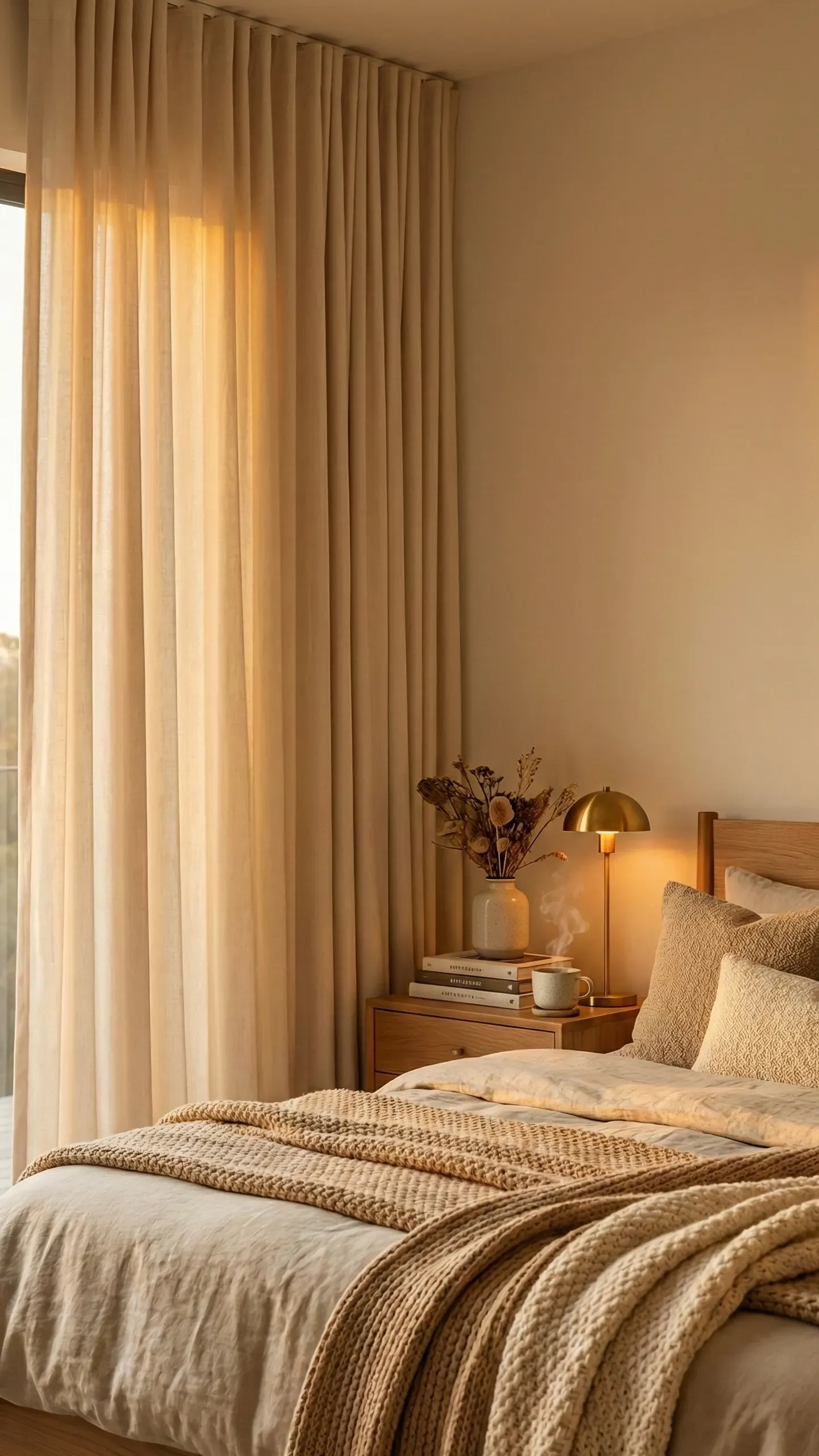
In Scandinavian bedrooms, the bed is not just where you sleep. It’s the visual centre of the room, and every other decision is made in relation to it.
This means the bed itself has to be worth looking at — which comes down to layering. A base duvet in the room’s warmest neutral. A lighter blanket folded across one end. Two or three cushions in different textures and similar tones. The throw draped, not placed.
The Scandinavian bed is not symmetrically perfect. One side slightly more piled, the duvet not squared off precisely. It looks like it was made by someone who cares how it looks but lives in it genuinely.
The move: Remove all cushions from your bed and replace with two or three in different textures (linen, wool, bouclé) within the same warm palette. Add one throw, draped across the foot of the bed on a diagonal rather than folded squarely.
A rug that gets you gently

The first sensation of the day is your feet on the floor.
That moment — before you’re fully conscious, before the day’s concerns have assembled themselves — sets something. Cold, hard floor reads differently from soft, warm textile. It sounds like a small thing. It isn’t.
A wool rug in the bedroom is partly practical (warmth, acoustics) and partly experiential. The morning moment is the experiential part: a room that receives you gently versus a room that doesn’t.
In a Scandinavian bedroom, the rug is almost always large enough that you land on it regardless of which side of the bed you get out of. Two-thirds under the bed, one-third extending into the room. It grounds the furniture and warms the floor in one move.
The move: Before buying a bedroom rug, mark the dimensions on the floor with tape. Stand back and look. Bedroom rugs are almost always purchased too small — the tape tells the truth.
The scent layer

Smell is the sense most directly linked to the emotional brain, and it’s the one most bedroom designs completely ignore.
A consistent scent in the bedroom — cedar, lavender, linen, sandalwood — becomes a cue. Your brain learns to associate it with rest in the same way it associates dimmed lights with sleep. Over time, the scent alone begins to slow you down.
Candles work, but not while sleeping. A diffuser with a timer runs for the evening and turns off. Dried botanicals and sachets are subtler and constant.
The Scandinavian approach is usually a candle lit during the wind-down, blown out as one of the last things before sleeping — a small ritual with a real effect.
The move: Choose one scent for your bedroom and commit to it for two weeks. Lavender and cedar are the classic choices. Notice whether the association builds.
The detail that makes it feel designed
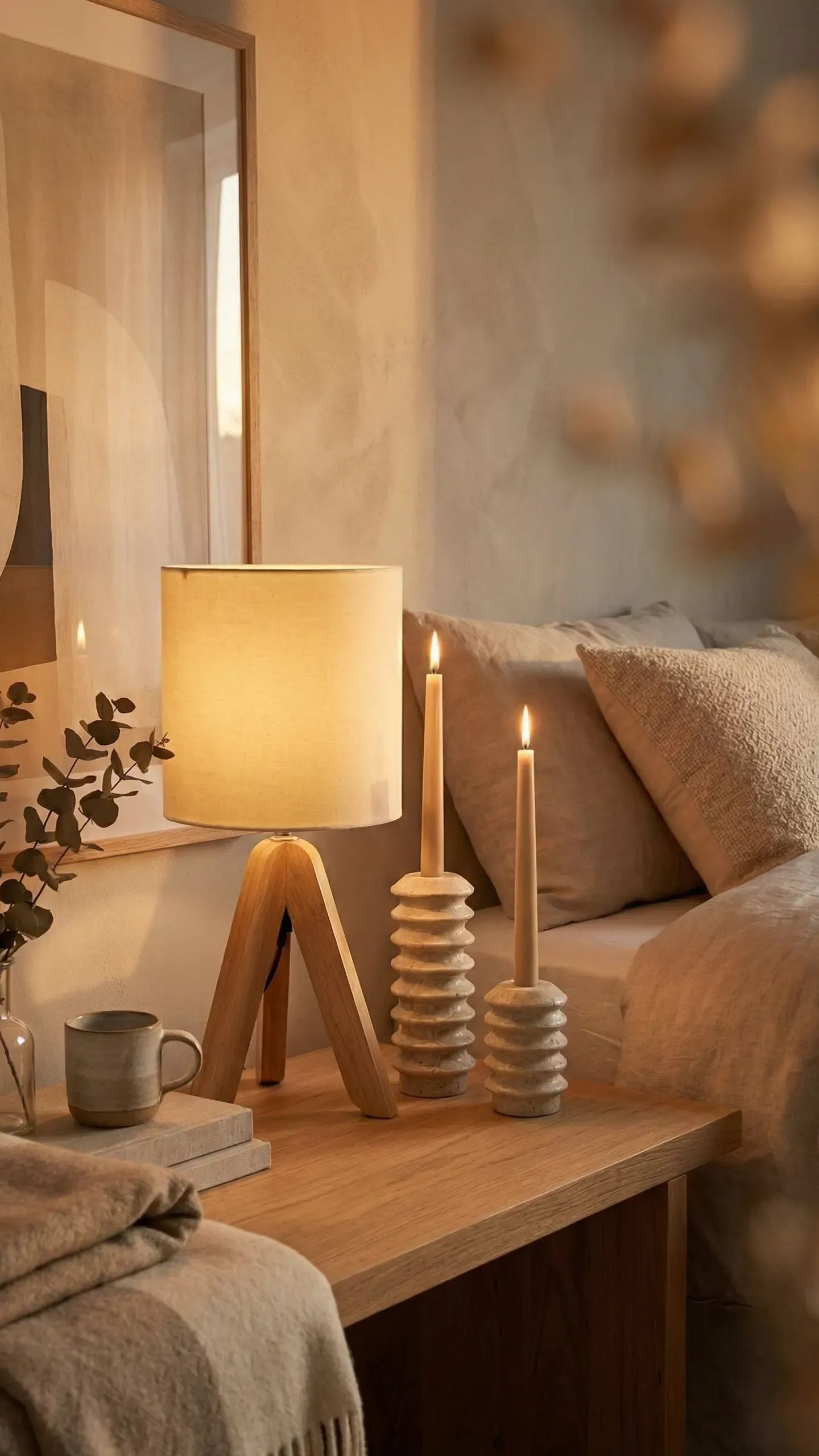
There’s always one detail in a well-designed Scandinavian bedroom that tells you someone thought about it properly. A handmade ceramic on the nightstand. A linen-covered lampshade. A single dried stem in a narrow-necked vase on the windowsill.
It’s not that the room is full of beautiful things. It’s that the few things in it were chosen — not inherited, not accumulated, not placed there because they needed somewhere to go. The bedroom is where the standard for this is highest, because the room is the most personal and the most intimate.
One beautiful, considered object in a bedroom of quiet surfaces does more for the room’s character than a hundred average ones.
The move: Identify one object in your bedroom that’s there by default rather than by choice. Replace it with something you actually love — not expensive, just right.
The free Scandinavian Styling Checklist — room by room, change by change.
The bedroom is one room in a free five-room checklist — the Scandinavian Styling Checklist walks you through every room with practical steps, from the changes that cost nothing to the things worth investing in. Download it free.


