Living Room
15 Cozy Scandinavian Living Room Ideas That Actually Feel Like Home

Jump to section
- Start with the light, not the furniture
- The sofa situation (and why yours might be working against you)
- The textile layer most people skip
- What to do with the walls (less than you think)
- The lighting shift that changes everything
- The shelf problem
- The floor (the thing everyone forgets until they’re cold)
- The one corner that makes the whole room
- Candles, always
- The final edit
There’s a version of Scandinavian design that looks incredible in magazines and feels completely wrong in real life.
Too white. Too empty. Too cold.
You sit down and instead of relaxing, you feel like you’re not supposed to touch anything. That’s not hygge. That’s a waiting room with better furniture.
The rooms that actually work — the ones you want to curl up in, stay in, live in — have a specific quality that’s hard to name but easy to feel. They’re warm without being cluttered. Calm without being sterile. Minimal, but somehow soft.
This is how they’re built.
Start with the light, not the furniture
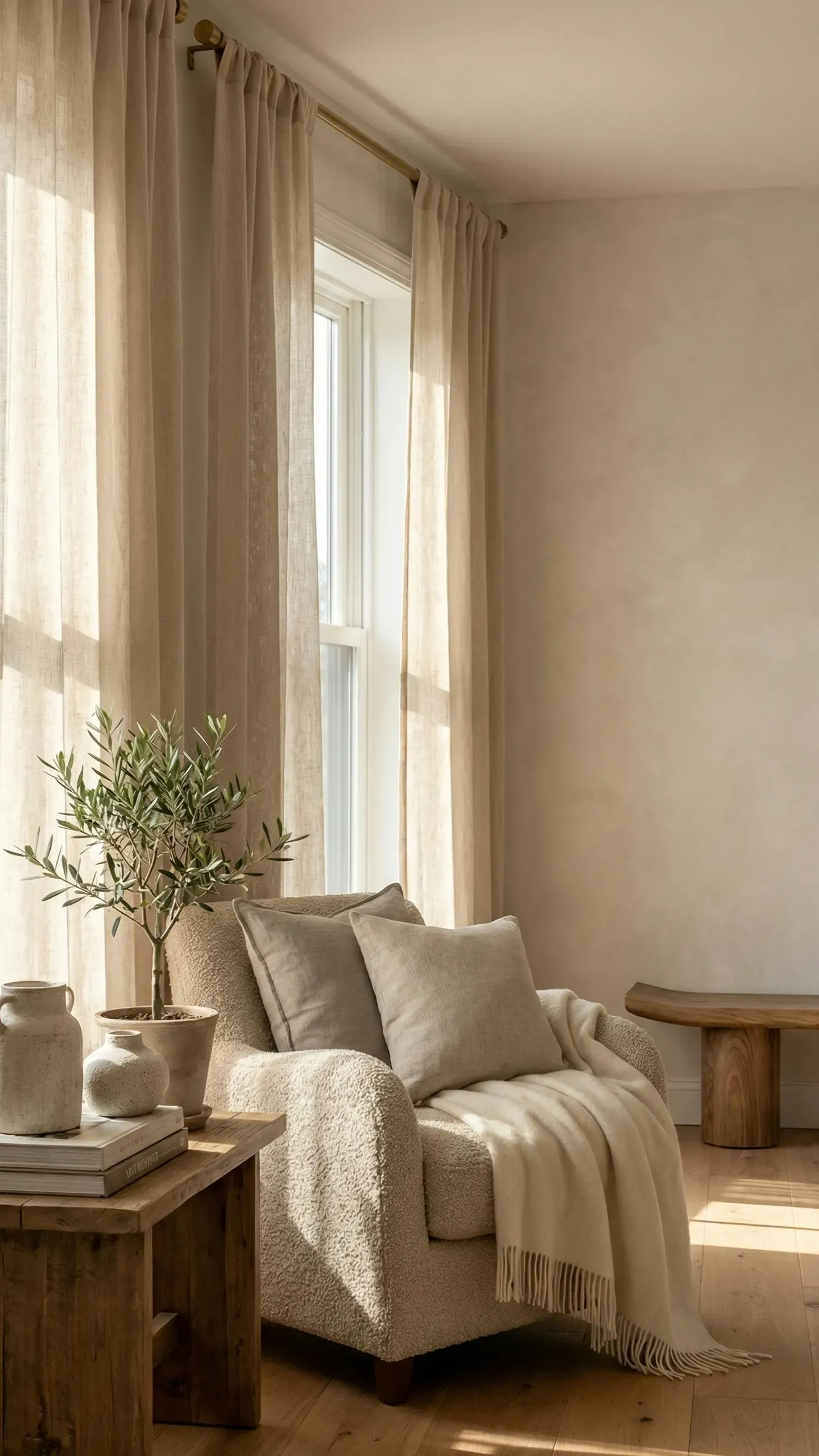
Most people start redecorating by buying something. A new sofa, a statement lamp, a rug they saw on Pinterest. But in Scandinavian design, the first move is always to clear the way for light.
Before you change a single thing: walk to every window in your living room and remove everything sitting on or near the sill. The plants, the picture frames, the stack of books. Just temporarily.
Then stand back and look.
What happens to the room when light can move freely is often dramatic — and free. Walls warm up. Corners soften. The furniture you already have starts to look like you chose it deliberately.
This is why Scandinavian rooms photograph beautifully even when they’re sparsely furnished. It’s not the furniture. It’s what they do with the light.
The move: Clear windowsills completely. Move one lamp into the darkest corner of the room. Switch every bulb to 2700K or lower. Do this before spending a single krona on anything else.
The sofa situation (and why yours might be working against you)
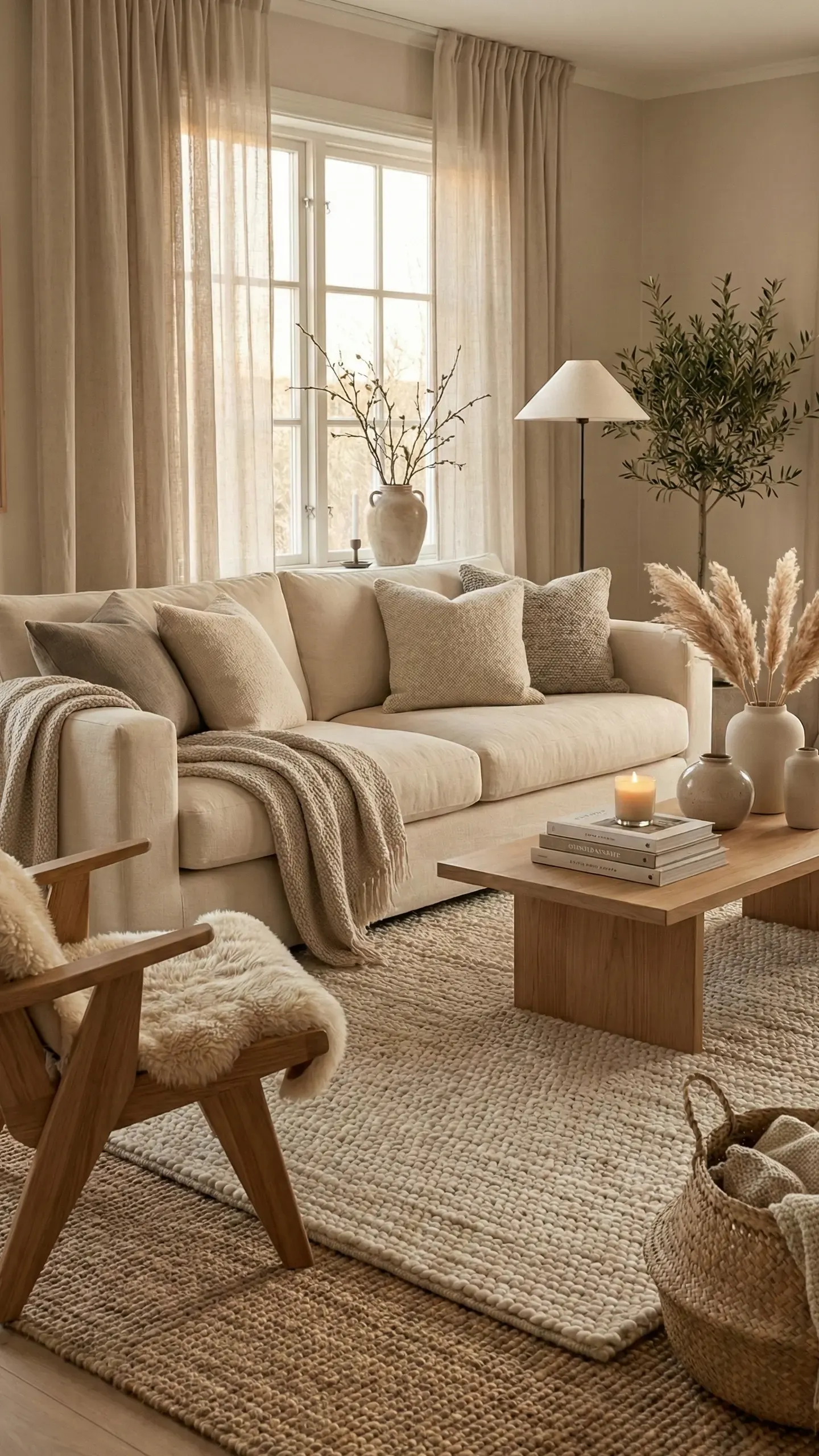
The sofa is the single biggest decision in any living room, and it’s also where most Scandinavian-inspired rooms go wrong in the same way: the sofa is too high, too dark, or too formal.
A Scandinavian sofa sits low and deep. It invites you to sink in, not perch on the edge. The colour is almost always in the warm white–to–sand family, which sounds like it would show every mark but in practice just reads as light and generous in the room.
If your sofa is dark — charcoal, navy, dark brown — it’s absorbing the light your windows are working hard to bring in. A washed-linen slipcover in oat or warm white costs a fraction of a new sofa and can genuinely transform the room.
The second sofa mistake is treating it as a surface. Cushions piled into geometric arrangements, throws folded with hospital corners. A Scandinavian sofa is slightly undone — a throw draped over one arm, cushions in two or three sizes and textures rather than a matching set, a book or two half-tucked in a corner.
It should look like someone was just sitting there. Because someone should be.
The move: If you can’t change the sofa, drape one chunky knit or linen throw casually over one arm — not folded, not arranged. Replace any matching cushion sets with two or three cushions in different textures: one linen, one wool or bouclé, one slightly textured cotton.
The textile layer most people skip
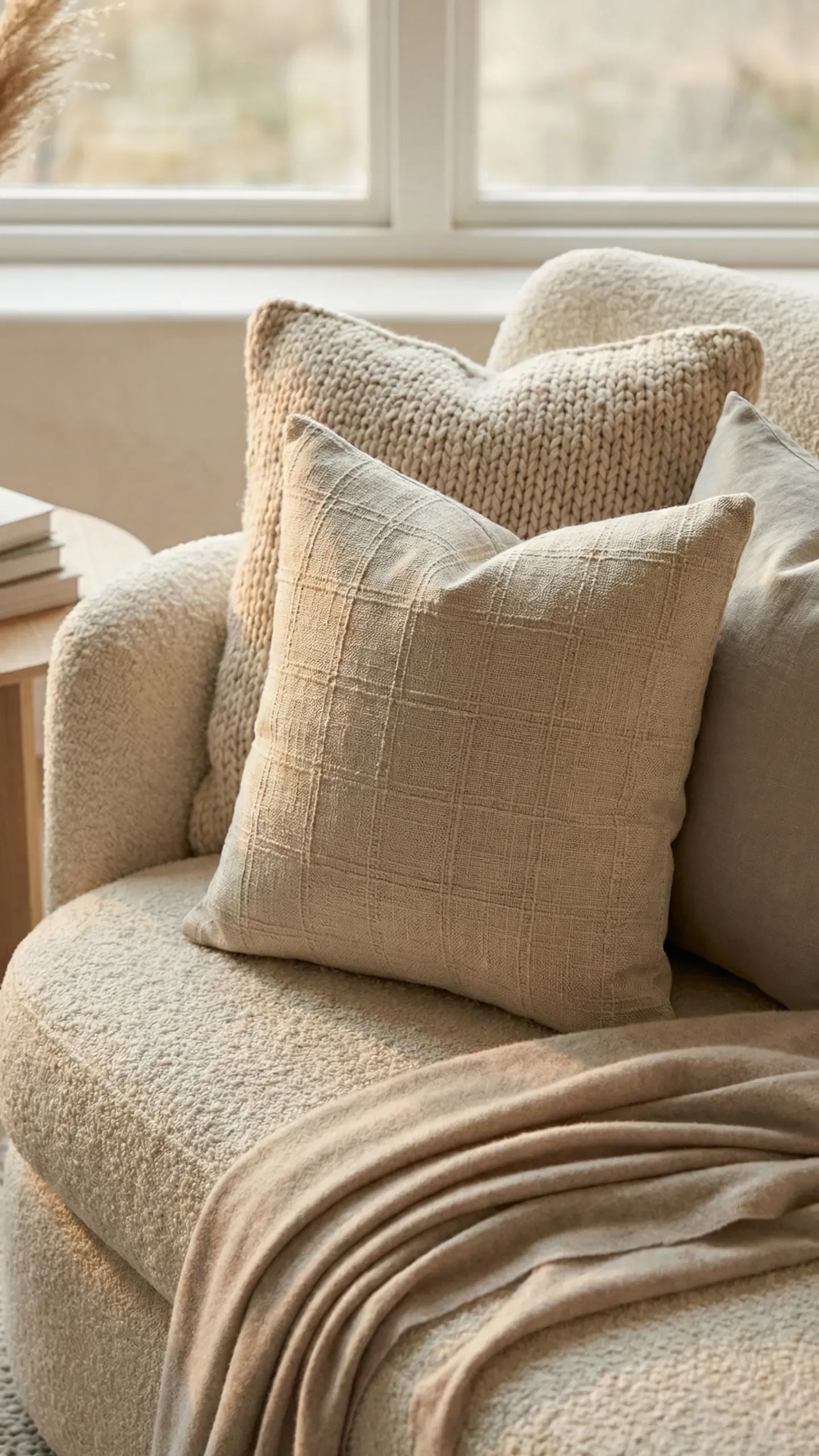
Here’s the thing about neutral rooms: without texture, they’re just beige.
The warmth in a Scandinavian living room comes almost entirely from how many different materials are in close proximity. Wool against linen against oak against ceramic. Each one catches light differently, each one feels different when you touch it, and together they create a richness that no single colour accent can match.
Most people get this partially right — a nice sofa, a rug, some cushions. What they miss is the variety of texture within the same neutral palette. Three oat-coloured items in different fabrics will always look more interesting and more expensive than three items that match exactly.
The materials that do the most work in this room: bouclé (one armchair or a few cushions — it photographs beautifully and feels extraordinary), washed linen (cushions, curtains, throws — the wrinkles are part of it), chunky wool (throws, a rug, heavier cushions for winter), and natural fiber rugs in jute or sisal as a base layer.
The rule isn’t to have all of them. It’s to have at least four different textures visible from where you usually sit.
The move: Count the textures visible from your sofa. If it’s under four, add one. A single bouclé cushion or a jute rug does more for the room’s warmth than almost any other single purchase.
The free Scandinavian Styling Checklist — room by room, change by change.
What to do with the walls (less than you think)
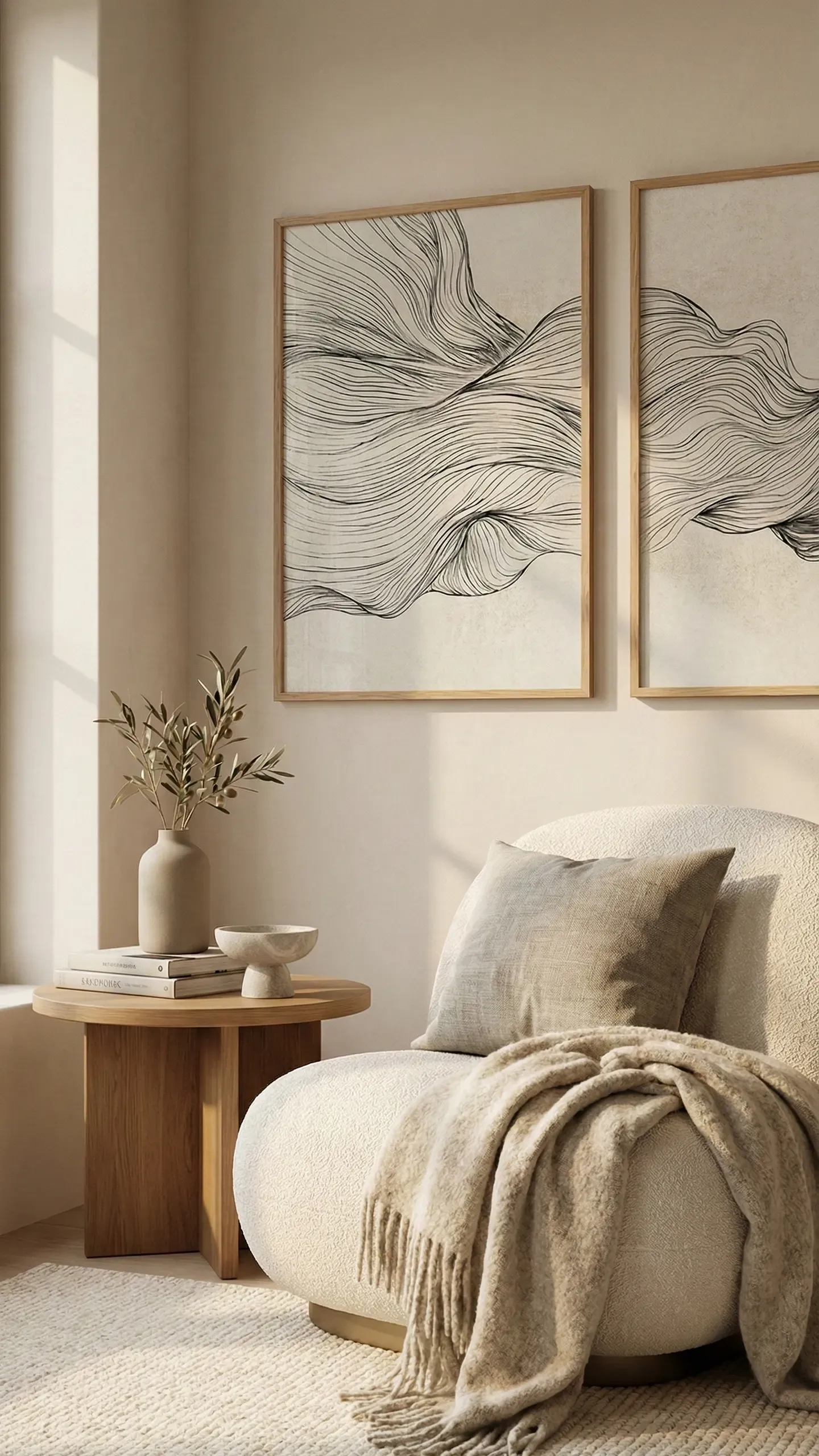
Scandinavian living rooms tend to have very little on their walls, and what’s there is usually large, calm, and in the room’s palette.
The instinct to create a gallery wall makes sense — you want personality, you have things you love, a wall feels empty. But gallery walls are high-contrast by nature: lots of frames, lots of different sizes, lots of visual stopping points. In a room built on calm, they work against the atmosphere.
The Scandinavian alternative is one large piece, hung confidently, given room to breathe. Abstract, tonal, quiet. Sometimes just a piece of handmade pottery leaning against the wall on a shelf, or a single framed botanical. The wall doesn’t need to be filled — it needs one good reason to look at it.
Art in this style almost always stays within the room’s palette. Not because there are no other colours in the world, but because art that blends into the palette adds depth without interrupting the calm. Art that contrasts loudly becomes the whole conversation.
The move: If you have a gallery wall, take everything down, live with the empty wall for a week, then put back only the one piece you miss most. If you have nothing: one large print in your colour palette, leaned rather than hung, is both lower commitment and somehow more relaxed-looking.
The lighting shift that changes everything
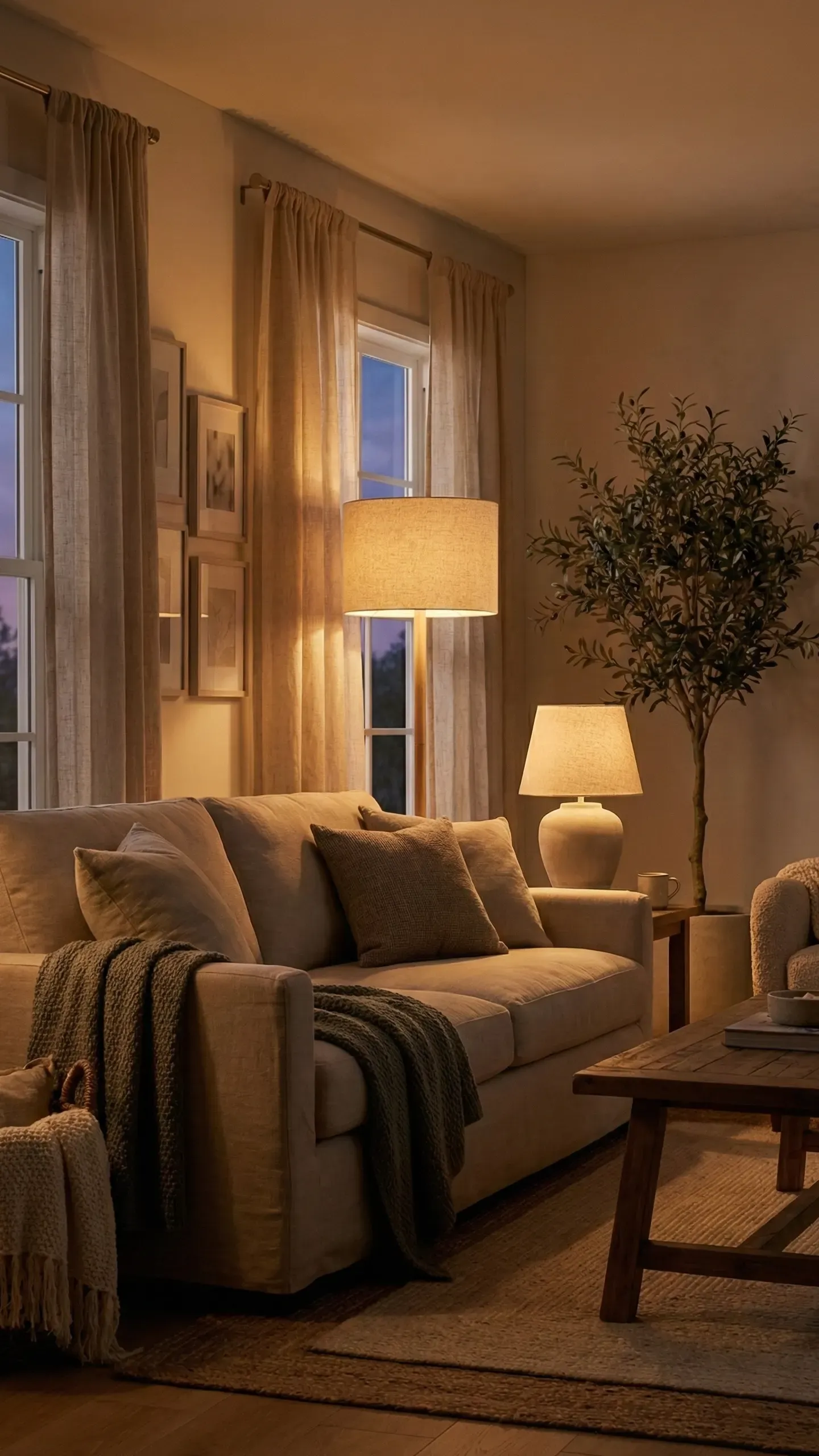
This is the change that makes more difference than any furniture purchase, and almost nobody does it.
Stop using the overhead light in the evening.
Overhead lighting floods a room evenly and kills atmosphere completely. It’s useful for cleaning and finding things you’ve dropped. It’s genuinely bad for the feeling of a room after about 5pm.
Scandinavian homes typically have no overhead lighting at all in the living room — or if they do, it’s on a dimmer and set very low. Instead: multiple light sources at low heights. A floor lamp in the reading corner. Table lamps on either side of the sofa. A lamp on a sideboard. Maybe a cluster of candles on the coffee table.
The goal is pools of warm light rather than uniform bright light. Your eye rests between the pools, which creates both visual calm and the physical sensation of being held by the room rather than exposed in it.
The move: Tonight, turn off the overhead light and see how many lamps you can switch on instead. If it doesn’t feel like enough, you need more lamps — not brighter bulbs. Add one floor lamp to the darkest corner this week. The impact is immediate.
The shelf problem
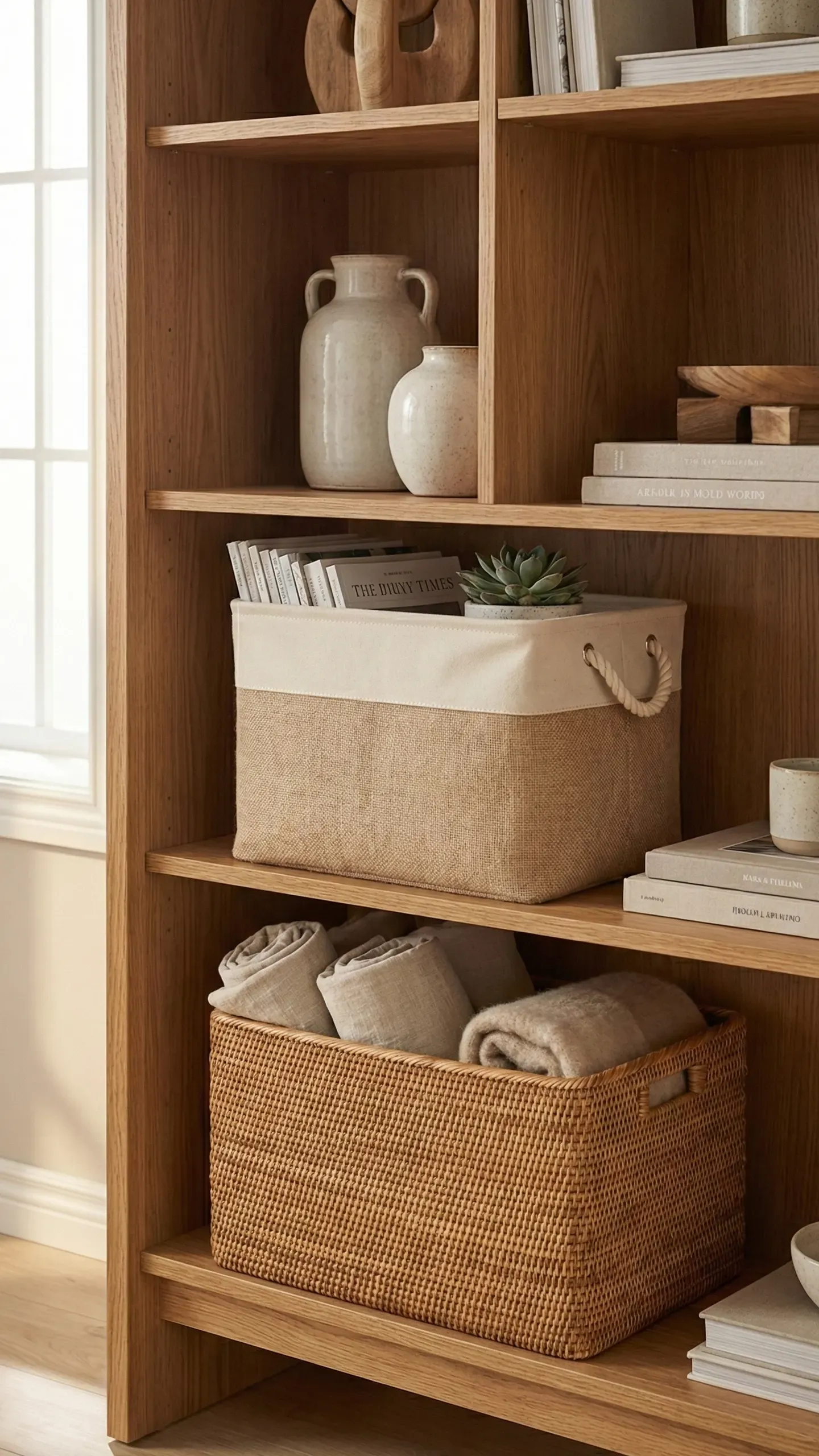
Open shelving is one of the most characterful elements in a Scandinavian room and one of the most commonly overdone.
The mistake isn’t having stuff on shelves. It’s treating shelves as storage that’s been made to look decorative, rather than decoration that happens to hold things.
The Scandinavian shelf has breathing room. Between groups of objects, there’s actual space — not crammed, not even full. You can see the shelf itself as part of the composition. Books are grouped by colour or size rather than crammed in alphabetically. Some spines face in. Objects come in groups of three at most, then a gap, then the next group.
The ceramics on these shelves aren’t there because they need somewhere to live. They’re there because they’re worth looking at, and they’re given enough space that you actually look at them.
The move: Remove half of what’s currently on your shelves. Rearrange what’s left into groups of two or three with visible gaps between. You almost certainly won’t need to put anything back.
The floor (the thing everyone forgets until they’re cold)
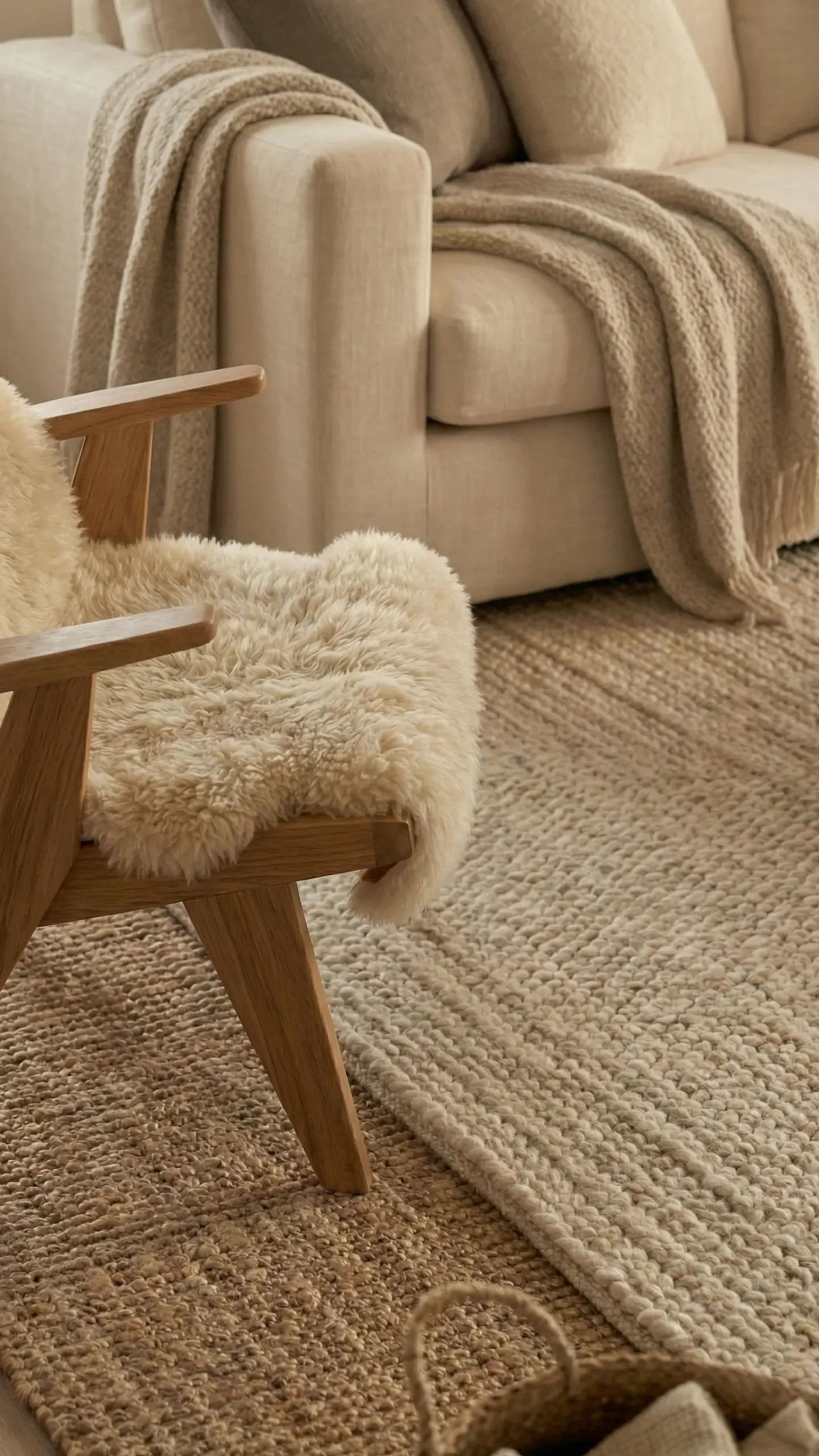
Bare floors look clean and minimal in photographs. In real life, they make rooms feel cold, echoey and unfinished.
A rug is not optional in a Scandinavian living room — it’s structural. It visually defines the seating area, warms the acoustic quality of the room, and gives your feet somewhere soft to land. It also grounds all the furniture into a cohesive arrangement rather than objects floating around a room.
The most common rug mistake: too small. A rug where only the coffee table sits on it, with sofa legs well off the edge, makes the room feel like the rug is a decoration rather than an anchor. The front legs of every piece of seating should sit on the rug, minimum.
For material: wool rugs are warm, age beautifully and handle traffic. Jute or sisal is slightly cooler-looking and very durable. Layering a smaller wool rug over a large jute one is both practical and adds the kind of casual texture this style depends on.
The move: Measure your current rug and where the furniture legs actually land. If anything is floating, you need a larger rug. This is worth the investment — the wrong-sized rug is one of the most expensive-looking problems in any room.
The one corner that makes the whole room
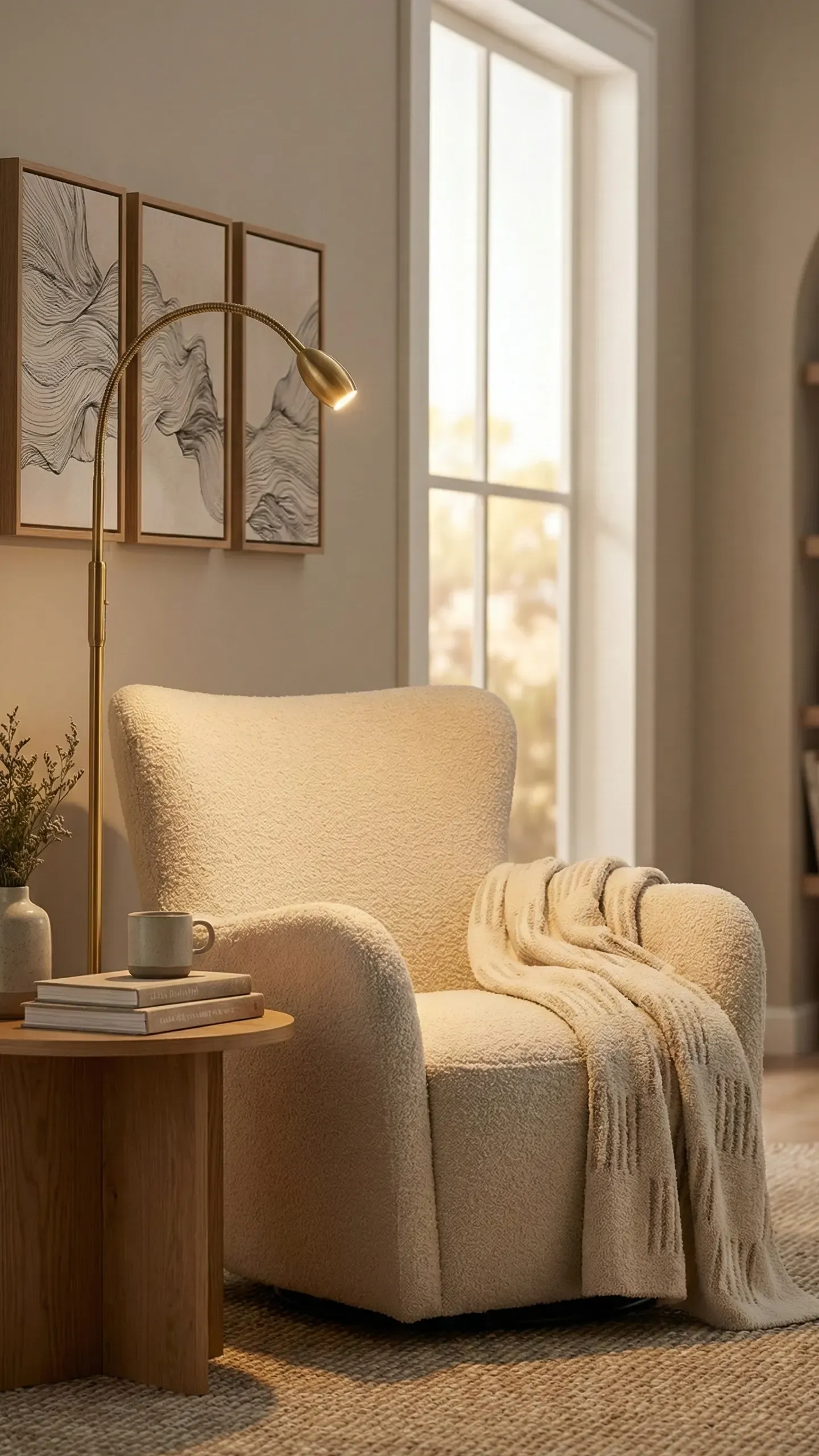
Every Scandinavian living room has what you might call a hygge corner — one spot that’s been deliberately designed for one person to be comfortable in.
Usually it’s a chair. A good one: bouclé or wool upholstery, wood legs, deep enough to sit sideways in. Angled slightly away from the main seating area, toward a window if possible. A floor lamp positioned so it reads by. A small side table at the right height for a cup of tea or a glass of wine.
This corner doesn’t just look good. It changes how you use the room. Instead of defaulting to the sofa and staring at a screen, you have somewhere to go that’s designed for being still and present.
It’s the most intentional square metre in the room, and it makes everything else feel more intentional by extension.
The move: Identify your living room’s darkest or least-used corner. Put a chair there (even a dining chair temporarily). Add a floor lamp. See if you sit there. If you do, you’ve found where to invest.
Candles, always
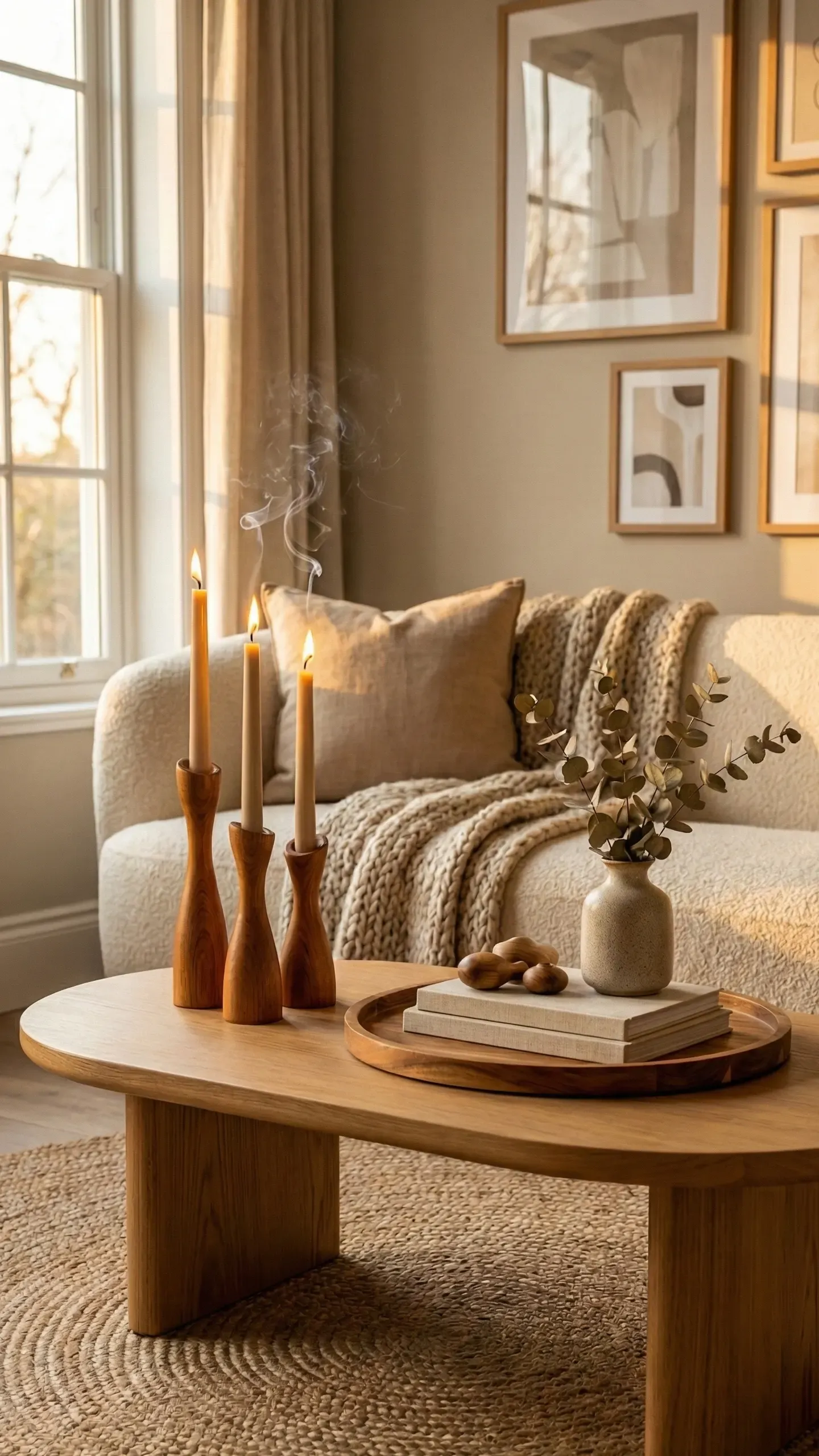
This is not negotiable.
Candles in a Scandinavian home aren’t for special occasions. They’re for Tuesday evenings and Sunday mornings and every grey afternoon in between. They’re lit when you make coffee, blown out when you go to bed.
The effect isn’t just visual. Candlelight at 2700K or warmer is genuinely calming in a way that even the best lamp can’t quite replicate. It flickers. It has depth. Your nervous system responds to it differently.
The styling move: cluster candles on a tray. Odd numbers, varying heights, the same general colour family (warm white, off-white, sand — not a rainbow of colours). The tray contains them visually, makes them easy to move, and means the coffee table looks styled even when the candles aren’t lit.
The move: Buy five candles this week. Put them on a wooden or stone tray on the coffee table. Light them tonight and see what happens to the room at 7pm.
The final edit
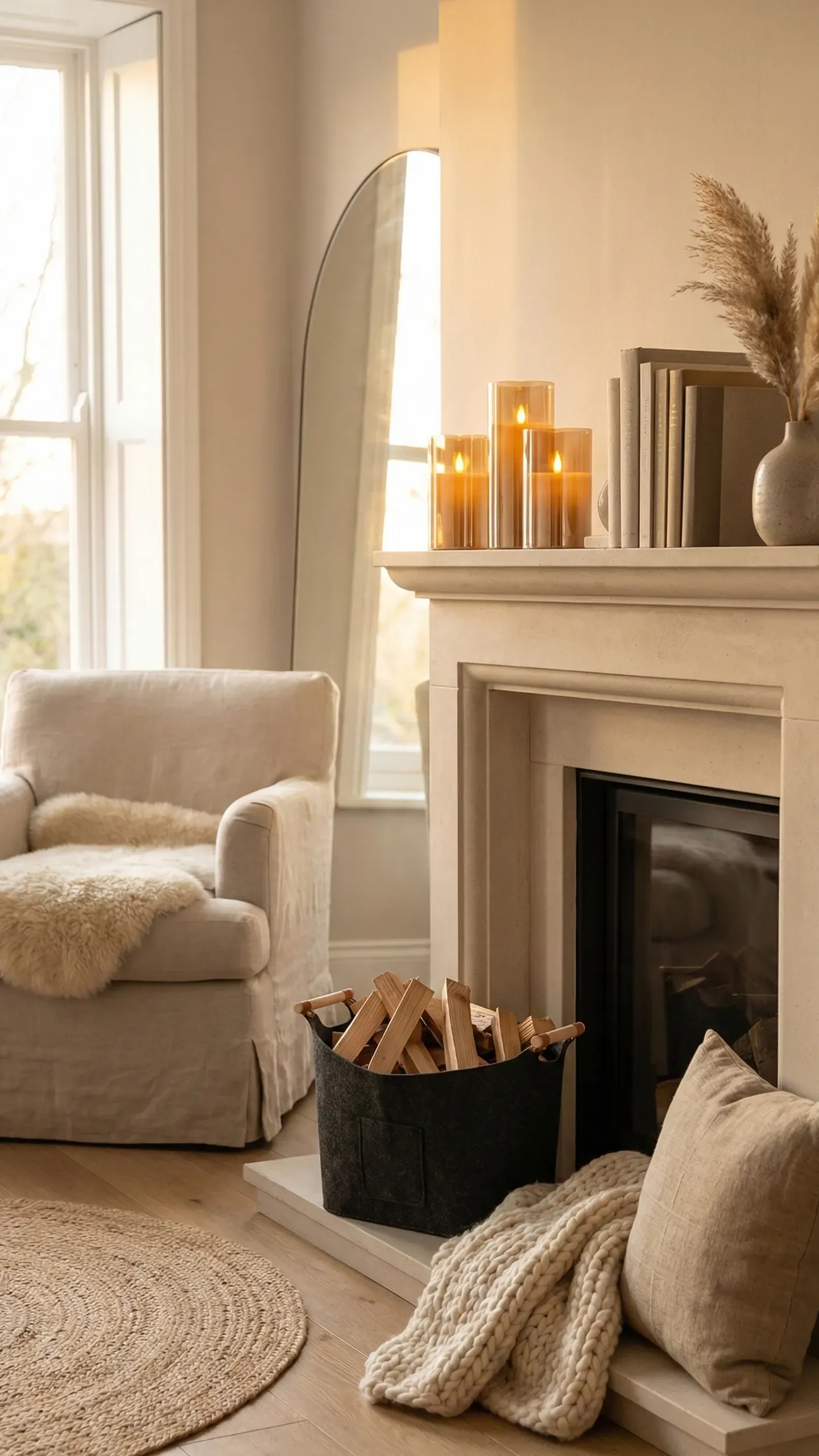
Here’s the hardest thing about Scandinavian style, and the reason most rooms never quite get there: it requires ongoing editing, not just initial styling.
The look doesn’t happen once and then stay. It needs the same attention that a garden needs — regular removal of things that have accumulated, a seasonal rethink of what stays and what goes.
Every surface in this room should have a reason for everything on it. Not a nostalgic reason, not a “it’s been there for years” reason — a considered reason. Does this add calm? Does it add light? Does it add warmth? If not, where does it actually live?
The rooms that stop you mid-scroll are the rooms where someone made that decision about every single object. The cushion, the lamp, the vase, the stack of books. Each one placed, not placed there by default.
That’s not cold. That’s not a showroom. That’s a home where someone is paying attention to how it feels to be there.
That’s the room you’re building.
The free Scandinavian Styling Checklist — room by room, change by change.
Want a room-by-room version of this to work through your whole home? The free Scandinavian Styling Checklist walks you through every room with the same approach — what to remove, what to add, what’s worth upgrading. It’s free, and it takes about ten minutes per room.


